BREAKING
Kevin McCarthy says obama is secretly running the Kamala Harris campaign

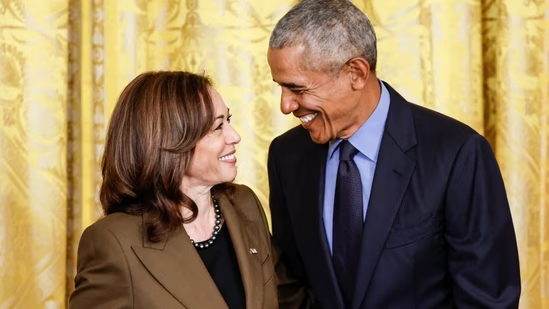
In a surprising development that has sparked intense reactions among conservatives, former House Speaker Kevin McCarthy recently made a bold claim during an interview on 770 WABC’s “The Cats Roundtable.” According to McCarthy, former President Barack Obama isn’t just a passive supporter of Kamala Harris’s presidential campaign; he’s allegedly the one pulling the strings behind the scenes. This allegation has stirred significant debate about the true extent of Obama’s involvement and its potential impact on American democracy.
McCarthy’s assertion goes beyond mere political endorsement, suggesting instead that Obama is exercising control over Harris’s campaign. He pointed out that several key members of Obama’s inner circle, such as David Plouffe, who played a crucial role in Obama’s 2008 campaign, are now central figures in Harris’s team. To McCarthy, this isn’t just a coincidence or a simple show of support; it’s a strategic move that suggests Obama’s influence is far more significant than previously thought.
If McCarthy’s claim holds any truth, it raises concerns about the continued influence of former presidents in shaping the political landscape, not through elections but through behind-the-scenes maneuvering. His comments resonate with a broader conservative fear of a so-called “shadow government,” where former leaders like Obama continue to wield power, potentially undermining the democratic process.
The implications of McCarthy’s allegations are profound. If Obama is indeed guiding Harris’s campaign, it could suggest that the Democratic Party lacks confidence in Harris’s ability to manage her campaign independently. This scenario might be seen as an acknowledgment that Harris needs Obama’s expertise and influence to succeed—a perspective that could be viewed as a critique of her leadership capabilities.
McCarthy’s remarks also touch on a larger narrative within conservative circles regarding the direction of the Democratic Party. He describes the Harris-Walz ticket as “the most liberal ticket in the history of American politics,” a characterization that taps into conservative concerns about the party’s leftward shift. McCarthy implies that with Obama’s involvement, the party’s progressive policies are being pushed forward in a way that could potentially harm national interests.
Additionally, McCarthy criticized Harris’s choice of running mate, Tim Walz, arguing that she passed over more centrist figures like Pennsylvania Governor Josh Shapiro. According to McCarthy, this decision could alienate voters in crucial battleground states, highlighting what he sees as a strategic error influenced by Obama’s circle rather than by fresh, voter-focused approaches.
This situation paints a picture of a campaign that may not be led by its official candidate but by a former president, raising questions about genuine leadership within the Harris campaign. For many conservatives, the issue is not just about winning or losing an election but about the integrity of the democratic process. They worry about the influence of unelected officials and the potential emergence of a political dynasty where former leaders continue to exert control from behind the scenes.
As this story continues to unfold, McCarthy’s accusations are likely to galvanize those who believe in transparency and the importance of political leaders who can stand on their own merits, without relying on the legacy of their predecessors. Whether or not Obama’s involvement is as extensive as McCarthy suggests remains to be seen, but the mere possibility has already cast a long shadow over Harris’s presidential bid.