BREAKING
BREAKING: Top NFL Quarterbacks’ Wife Shows Support For Trump…

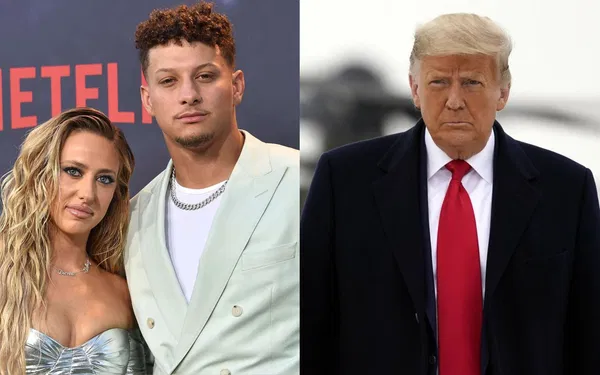
In the ever-polarizing landscape of American politics, where every action, no matter how trivial, can become a battleground, Brittany Mahomes, wife of NFL star Patrick Mahomes, found herself at the center of controversy.
Her apparent endorsement of a Donald Trump post on social media sparked a firestorm, revealing the deep divisions that permeate even the world of sports celebrities.
Brittany Mahomes, known for her vibrant presence on social media and her involvement in the Kansas City Current, a professional soccer team, stepped into a political minefield when she liked a post outlining Trump’s 2024 campaign platform.
This wasn’t just any post; it was a bold declaration of conservative values, including promises to deport radicals, secure elections, and keep men out of women’s sports.
For many, this was more than a simple social media interaction; it was a statement of political allegiance.
The backlash was immediate and fierce. Critics, many from the liberal echelons of social media, pounced on this as evidence of hypocrisy or worse, a betrayal of progressive values they assumed all celebrities, especially those with significant platforms, should uphold.
Here’s where the narrative gets interesting from a conservative viewpoint. Why should Brittany Mahomes, or anyone for that matter, be vilified for supporting a candidate whose policies resonate with them?
The reaction to Brittany’s like underscores a broader issue within American discourse: the intolerance for differing political views.
Conservatives argue that this incident highlights the left’s cancel culture, where any deviation from their ideological path is met with scorn and attempts at public shaming.
Brittany, married to a Black man with mixed-race children, was accused of inconsistency with her support for Trump, ignoring the possibility that individuals can hold complex, nuanced views not easily boxed into racial or political stereotypes.
From a conservative perspective, this incident is a microcosm of the broader assault on free speech and thought.
Brittany’s action, a mere like on a post, was blown out of proportion, reflecting a society increasingly uncomfortable with dissent.
Conservatives might argue that this reaction is indicative of a left-leaning media and public that demands conformity over diversity of thought.
Moreover, the criticism Brittany faced for her political stance could be seen as an attack on the very fabric of American democracy, where individuals are supposed to engage with political discourse without fear of reprisal.
This event serves as a stark reminder of how political polarization has seeped into every aspect of public life, turning even sports figures and their families into political pawns.
Brittany Mahomes’ response to the backlash was equally telling.
Instead of retracting or apologizing, she stood her ground, albeit indirectly, by sharing messages advocating for kindness and acceptance of differing views.
This stance might resonate more with conservatives who value individual liberty and the right to one’s political beliefs without the mob’s judgment.
In conclusion, Brittany Mahomes liking Donald Trump’s post isn’t just about a celebrity’s political leanings; it’s a reflection of the times we live in.
It’s about freedom of expression, the right to support any political figure without being ostracized, and the need for a society that can handle political diversity without resorting to vitriol.
From a conservative lens, this episode is less about Brittany Mahomes and more about the state of American political discourse, where even a like on social media can ignite a debate on freedom, tolerance, and the essence of democracy.